

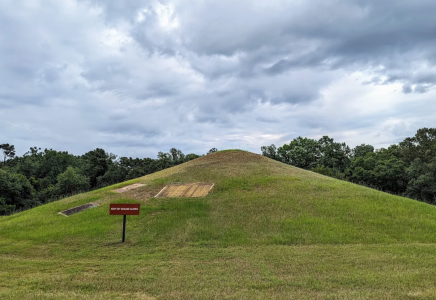
Ocmulgee Mound today in Bibb County, Ga.
James Adair’s History of the American Indians (London, 1775) was one of the first monographs published on the Southeastern Indians in the English-speaking world. Although Adair had a fallacious theory that the Indians were descended from Jews that wandered into Asia and across the Bering Strait to the Americas, his account of Southeastern Indians’ culture and lifeways is nevertheless quite valuable as eyewitness information in the fields we now know as anthropology and ethnology.[i] At the time he wrote in the mid-18th century, the center of gravity for the Southeastern Indian nations was in Georgia, in White County, capital of the Apalachite kingdom (Melilot, controlled by the Knights of Malta). Here Adair lived with a half Jewish, half Chickasaw “Indian princess,” who was his informant, evidently, on many aspects of Jewish life. Chickasaw and Choctaw were not firmly separated, and Choctaw was the unifying language of a large part of the Southern Highlands. Later, these tribes moved more and more to the west: The Chattahoochee River was “the river of the Choctaw.”
Adair mentions that the priests who proceeded in advance of a migrating Indian group carrying their insignia or tribal pole were the Nani Ishtahoolo. Here the expression seems to mean “holy men, or priests.” In another passage (pp. 38-40), he uses the term to refer to spirits of the dead associated with burial mounds, or ghosts. He writes:
There are not greater bigots in Europe, nor persons more superstitious, than the Indians, (especially the women), concerning the power of witches, wizards, and evil spirits. It is the chief subject of their idle winter night’s chat: and both they, and several of our traders, report very incredible and shocking stories. They will affirm that they have seen, and distinctly, most surprizing apparitions, and heard horrid shrieking noises. They pretend, it was impossible for all their senses to be deluded at the same time; especially at Okmulge , the old waste town, belonging to the Muskohge , 150 miles S. W. of Augusta in Georgia, which the South-Carolinians destroyed about the year 1715. They strenuously aver, that when necessity forces them to encamp there, they always hear, at the dawn of the morning, the usual noise of Indians singing their joyful religious notes, and dancing, as if going down to the river to purify themselves, and then returning to the old town-house: with a great deal more to the same effect. Whenever I have been there, however, all hath been silent. Our noisy bacchanalian company might indeed have drowned the noise with a greater of their own. But as I have gone the tedious Chikkasah war path, through one continued desart, day and night, much oftener than any of the rest of the traders, and alone, to the Chikkasah country, so none of those frightful spirits ever appeared to, nor any tremendous noise alarmed me. But they say this was “because I am an obdurate infidel that way.”
The Hebrews seem to have entertained notions pretty much resembling the Indian opinions on this head, from some passages in their rabbins, and which they ground even on the scriptures. We read Isa. xiii. 21: “But wild beasts of the desart shall lie there, and their houses shall be full of doleful creatures, and owls shall dwell there, and satyrs shall dance there.”
Several warriors have told me, that their Nana Ishtohtollo, “concomitant holy spirits,” or angels, have forewarned them, as by intuition, of a dangerous ambuscade, which must have been attended with certain death, when they were alone, and seemingly out of danger; and by virtue of the impulse, they immediately darted off, and, with extreme difficulty, escaped the crafty, pursuing enemy. Similar to this, was the opinion of many of the Jews, and several of the ancient and refined heathens, and is the sentiment of moderns, that intimations of this kind, for man’s preservation and felicity, proceed from God by the instrumentality of good angels, or superior invisible beings, which he employs for that purpose—who can so impress the imagination, and influence the mind, as to follow the suggestions, but not so as to destroy the liberty of the will.—Thus Homer introduces Minerva as suggesting what was proper for the persons she favoured — and other superior beings; but they deliberated on the counsel, and chose that which appeared to be right.
We see from this passage, that Nana Ishtahoolo can mean angels, priests, spirits, ghosts or muses, divine inspiration. It is formed of the Choctaw language elements Nan(a) “beings, things,” Isht, a common verbal particle, and ahula “spirit,” or literally, “beings that do something with or in spirit.” The central concept is ahula, which can be applied to the living or the dead. In the story about the Ogmulgee mounds, it refers to the ancestors, who continue to go about their lives as usual in the afterworld.
The Indians of old took care to bury their dead near their homes and couldn’t understand why the white man (whom they called the Nothings[ii]) would leave the bones of their ancestors on the other side of the ocean. The Indians pitied the settlers because they seemed to be outcasts and had nothing—”no lodges, no food, no wives and children, no beautiful deerskins or fine feathers, none of the essentials of life.”[iii] Most of all, like Adair and his fellow Englishmen, they were not sensible to spirit.
[i] Charles Hudson, “James Adair as Anthropologist,” Ethnohistory 24/4 (1977), pp. 311-28.
[ii] “Nothings is the most favourable name they give us, in set speeches” (p 34).
[iii] Donald N. Panther-Yates, The Eighth Arrow (Longmont: Panther’s Lodge Publishers, 2014), pp. 65-66. The element hoolo seems to reflect the spiral movement signifying spirit in Indian sign language, a finger above the head circling in counterclockwise gyration, cf. Greek helix, Hawaian hilo, Cherokee gilo “twist.”
Related
Adena Tablets Are the Effects of Austronesian Merchants in Ancient America, blog post (Jan. 30, 2025)
The Countercurrents of Prehistory, book announcement (May 31, 2025)
Toward a New Story of the Mound Builders, blog post (Apr. 25, 2023)
write
comment