

How Genomic Companies Are Erasing Native American Ancestry
By DONALD N. YATES, DNA Consultants’ Owner, Founder and Chief Scientific Officer
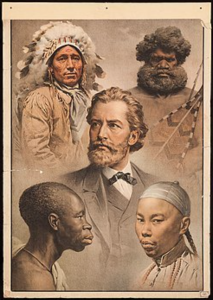
This textbook diagram from the nineteenth century illustrates the racial stereotypes many people hold even today. A light-skinned blue-eyed well dressed male with a patriarch’s beard is at the center of humanity.
Just for fun recently, I asked several friendly AI engines, “Did the ancestors of American Indians all come across the Bering Strait?” The answer: Not quite all, but at least none came across the Atlantic or Pacific. A few ghost populations like the South American Australoid hunter-gatherers of population Y were the only possible exceptions. And they are extinct, like Neanderthals and the dodo.
With the stroke of a key my family’s traditions about Native American admixture were made to seem invalid. I felt very small and foolish. Reading more about the mad rush to AI, however, I suspected that was the point. Knowledge once created power. Power now creates knowledge. The world cowers before billionaires who claim to be thinkers and even philosophers. Pope Leo XIV’s recent encyclical Magnifica Humanitas warns of the loss of identity, dignity and autonomy through the encroaching tyranny of AI.
I should say that my own company, which features customized reports written by human beings rather than robots, gave me strikingly Native American results, including Cherokee at the no. 3 highest match and American Indian as the no. 1 megapopulation. But we have a forensic method, not a genomic approach. And we don’t use generative AI. This article exposes some of the foibles of the automated genomics approach.
Not quite willing to let the matter rest, I went to a certain popular genomic company’s site (that will be nameless) and reviewed my DNA results. Surely there was a tiny amount of American Indian? Here is what the robots at that powerhouse of genetics and genealogy had to say about my “ancestral origins”:
What Wikipedia calls the Ubi Sunt theme echoes down through the ages, from the Bible’s lament “Where are the princes of the nations” to Catch-22‘s absurdist phrase “Where are the Snowdens of yesteryear.” DNA companies once conceded 8% American Indian heritage to me. Where did that go? Now even the name of it was missing.
Continuing on my journey of genetic discovery, I went to the genomic company’s “migration timeline” section. I learned that a bunch of people from these 18 European branches were settlers in the backcountry of the South who moved to Oklahoma. Here’s how AI phrased it:
Originating in the British Isles and Germany, these colonists took part in some of the largest human migrations in U.S. history. They had a gnawing appetite for land and were willing to face great risks to get it. Arriving from Europe, they settled in what was then the Southern Backcountry, east of the Blue Ridge Mountains. After the Revolutionary War, they settled throughout Tennessee and Kentucky before moving on to Oklahoma and Texas.
I know AI wrote that because it is free of mechanical errors but tellingly overwritten (look at “gnawing appetite”). Not mentioned are the thousands of American Indians who migrated to Oklahoma and Texas let’s say unwillingly. The genomics company apparently pretends not to know about them.
“Ubi Sunt Qui Ante Nos Fuerunt” (‘Where are those who were before us?’) is a Middle English song voicing this loss. François Villon asked,
Mais où sont les neiges d’antan?’Where are the snows of yesteryear?’
while the modern troubadour David Bowie recorded the song “Where are we now?” in secret toward the end of his life.
In defense of its changing opinions over time, the genomics company intones,
Your DNA doesn’t change, but our knowledge does. Over time, the amount of data we have increases, and we improve the ways we can analyze it. When that leads to new discoveries, we update your results.
My results at the genomics company in question were last updated in October. But then as now, in the defiant words of Josie Kuhn (who died in Nashville, March 2026), native identity was very much still alive:
From the California redwoods to the North Atlantic sea
The Badlands of Dakota and the hills of Tennessee,
All along the Rio Grande down to Mexico
This land was our land a long, long time ago.
We’re still here
Thinking I might find something interesting in the genomics company’s “Traits” section, I read with a mix of amusement and horror that:
- I was unable to smell asparagus (not true). No
- I was very likely to enjoy cilantro (true).
- I was less likely to have unattached earlobes (I have long pendulous ear lobes, like many American Indians).
- I was very likely to have thin hair (I have thick hair).
- I was unlikely to be an optimist (true, as of most marginalized ethnicities).
- I had a very light skin tone (I have an olive or tan skin tone).
- I was very likely to have genes for a lower chance of hair loss (probably true, but not attributed correctly).
Many of these genetic tendencies were ascribed to Central Scotland and Northern Ireland roots (supposedly 22% of my makeup). None was believed to come from Indian admixture, because… well, no Indian admixture had been detected by the genomic approach. I had to wonder why anyone would take a DNA test to find out what kind of skin tone they had. Can’t people look in the mirror? All together, most of the results in this list of inherited predispositions, physical and mental, struck me as either trivial or wrong, off base. Merely to offer them is like the tail wagging the dog. “We have them because other companies have them and there is scientific literature on them and what is the harm of getting some of them wrong in individual cases?” The trouble is you do not have a good approach or sufficiently comprehensive data or admirable motives or right intentions. The harm is making people think they are genetically determined only and less than what they truly are. Ancestor seeking is more serious than a recreation.
This genomics company certainly cannot be accused of telling customers what they want to hear. Unlike our clientele at DNA Consultants (who often tell us they searched and searched for their Native heritage without finding anything before using us), the DNA industry can afford to be arrogant and high-handed. The results and explanations are all automated and robotic. I doubt anyone can get a live person on the phone to dispute anything or answer questions. If the latter are not in the FAQs, forget it. And nowhere do we find an Ubi Sunt type of question.
In Joseph Heller’s Catch-22, the protagonist, John Yossarian, asks the ridiculous unanswerable question “Where are the Snowdens of Yesteryear” in a brainwashing session at his army base where he attempts to be declared mad so he is grounded from flying war missions. Snowden was a wounded colleague of his who died from inadequate emergency medical care (another comrade-in-arms had stolen drugs to sell on the black market). Yossarian fails in his quest to be declared crazy because, as one of his superior officers says, “The only people permitted to ask questions were those who never did,” so by asking the question he falls prey to “Catch-22.” He can’t be crazy because he’s asking or not asking the obvious sane question how can the army let so many of its soldiers die for nothing.
In genomics testing of the sort I have complained about here, there is a catch, too. If you have to ask where is the Native American, your Native American, you don’t seem to have any. The question is rhetorical. Most of it has vanished with the melting snows.
Incidentally, one of the other genomic companies told me I have a 98% probability of developing the fatal disease called lupus. Don’t think so. I’m still here
Further Reading and Listening
Scandinavians, Irish, Libyans and Iberians formed part of the ancient sea rovers who helped colonize North America and left their genes among the natives beginning about 1200 BCE. This is the third episode in our ongoing series titled “More Cherokee Descendants Who Proved the Geneticists Wrong.”
Private Alleles Reveal Minor Ancestry

It is widely accepted that STRs are non-coding in nature and are therefore not implicated in gene expression. By the same token, scientists used to think that single variations in the number of repeats (STRs) in your autosomal profile could not be correlated with population or ancestry, that you needed at least four STR alleles to reach meaningful conclusions.
A Real Indian Belongs to a Federally Recognized Tribe—a Wannabe Doesn’t
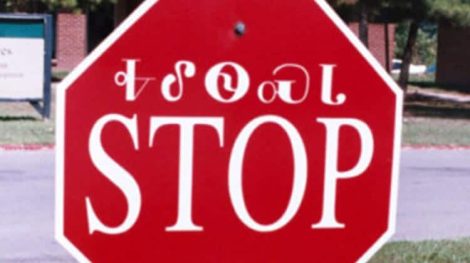
Review of Circe Sturm, Becoming Indian (April 1, 2015) by Donald N. Yates. That is the take-away from an academic study often cited by people denouncing “pretendians.” Becoming Indian by Circe Sturm appeared several years ago as a blue ribbon publication of The School for Advanced Research in Santa Fe, N.M. It is likely to be used and cited widely by schoolteachers, tribal educators and government workers.
Genealogist Donald Yates Uncovers Secrets of Cherokee DNA

In an interview by Emily Frances, host of the Israeli news show “Holy Land Uncovered,” author and DNA investigator Donald Yates discusses his own family traditions, which combine Cherokee, Choctaw and Sephardic Jewish roots.
Paul Yates
25 June, 2026 at 11:14 am
Great recent post even if the frustrations caused by their “catch-22” policies aren’t so great.
Jane Voitle Mellin
13 July, 2026 at 2:13 pm
Fascinating reading with a spice of wit. Donald Yates is a lion in the field of world genealogy; DNA Consultants is well worth hiring to analyze your genes; they discovered my Romany ancestors from the Alsace-Lorraine, which I’m sure beats the competition hands down.