

South American Indian Populations Doubled
Fight or Flight on the Amazon
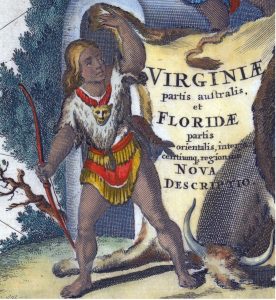
English settlers depicted the Azuli Indians (Children of the Sun, Euchee or Austronesians) as having Amazonlike women, who used a bow and arrows like men. The physical type resembled Polynesians. John Ogilby and Arnoldus Montanus, Virginiae partis australis et Floridae partis orientalis… (London, 1673).
Many customers are surprised to get high matches to South American Indian tribes like Belem Amazonians (n=325) and Ecuadorian Kichwas (n=115). Even if one’s ancestry includes Cherokee or some other type of North American Indian, it is not uncommon to have matches to Central and South American Indians, since all indigenous populations of the Americas are related by origin and came through narrow bottlenecks. Moreover, there has always been a great deal of mixing, migrating and movement back and forth.
As part of DNA Consultants’ basic research, we have recently doubled the number of South American indigenous tribes in our database from six to twelve. Data for the new native populations—all Amazonian—come from a single study.[1] Analysis of these additional populations suggests new inferences about the deep human history of the Brazilian rainforest. Surprisingly, there is little or no support for the notion of a single movement of people at one time only from the North (Bering Land-Bridge Theory), as widely posited by geneticists.
Contradicting the early settlement patterns “proved” by a major study earlier this year with its four Siberian populations (Amazonians, Andeans, Chaco Amerindians and Patagonians),[2] STR frequency data analyzed by the DNA Consultants forensic research team suggest rather an Austronesian origin or co-origin, one similar to the Euchee and neighboring tribes in North America.[3]
Awa-Guaja Tribe
Take for instance, the Awa-Guaja people living deep in the jungle in the state of Maranhão. With a frequency of 66%, they have the highest incidence worldwide of what DNA Consultants dubbed the Sundaland Gene, a value of 10 at the standard forensic location of THO1. The Waiapi, who live in the southeastern border area of French Guiana at the confluence of the rivers Camopi and Oyapock have the world’s second highest level (43.5%). The average incidence among all South American tribes is 15%, the same as Java in the Austronesian and Sundanese heartland.
Populations with High THO1=10
| Rank | Population Name in Forensic Science | % Freq. |
| 1. | South America – Amazonian – Awa-Guaja (n=34) | 66.0 |
| 2. | South American – Amazonian – Waiapi (n=23) | 43.5 |
| 3. | Java (n = 60) | 15.0 |
| 4. | South American – Amazonian – Parakana (n=24) | 14.6 |
| 5. | South American – Amazonian – Urubu-Kaapor (n=68) | 13.2 |
| 6. | Malaysian – Sarawak – Iban (n = 195) | 12.6 |
| 7. | Indonesian – Java (n = 105) | 11.9 |
| 8. | South American – Amazonian – Tiriyo (n=41) | 11.0 |
| 9. | Mexico – Oaxaca – Mixe (n=30) | 10.0 |
| 10. | Thai (n = 210) | 9.5 |
| 11. | Bali (n = 79) | 9.5 |
| 12. | Indonesian – Sumatra – Minangkabau (n=25) | 8.0 |
| 13. | Filipino (n = 106) | 7.5 |
| 14. | Taiwan (n = 79) | 7.0 |
| 15. | India – Sakaldwipi Brahmin (n = 65) | 6.9 |
| 16. | Moroccan (n = 205) | 6.7 |
| 17. | Chinese – Singapore (n = 209) | 6.7 |
| 18. | India – Munda (n = 68) | 6.6 |
| Singapore – Malaysian (n = 161) | 6.5 | |
| Vietnamese – Hanoi (n = 178) | 6.5 |
With the new populations, the five strongest metapopulation matches are now:
South American Indian 15%
Thai 9.5%
Indonesian 8.6%
Taiwanese Aboriginal 7.00
Borneo Dayak 6.0
Considered by megapopulation, the top matches are:
American Indian 6.8%
Southeast Asiasn 6.5%
Austronesian 6.2%
Maenads and Mad Men
It is striking that the Waiapi live in the same region near the border with French Guiana as the Amazonian women on the upper Nhamunda River called Icomiabas (“women without husbands”) reported in 1954 by Brazilian businessman Eduardo Barros Prado. Are they of the same stock? Could a tendency toward a super-charged patriarchy creating a separate all-female society have developed there?
There may be a genetic component contributing to warfare and toxic masculinity. The THO1 or tyrosine hydroxylase 1 locus is different from all the other forensic sites we study. More than just an inert marker of ancestry (though it is that, too), THO1 is a gene that “does something.” The tyrosine hydroxylase enzyme is responsible for creating L-DOPA in the central nervous system, which produces dopamine, a precursor for the important neurotransmitters norepinephrine (noradrenaline) and epinephrine (adrenaline). Sometimes called the “fight or flight” reaction, these chemicals are part of the stress response.
Chronic stress contributes to high blood pressure, promotes the formation of artery-clogging deposits and causes brain changes that may contribute to anxiety, depression, and addiction. More preliminary research suggests that chronic stress may also contribute to obesity, both through direct mechanisms (causing people to eat more) or indirectly (decreasing sleep and exercise). The way we experience stress also has evolutionary fallout, favoring some people and handicapping others in a population.
Although forensic DNA profiling utilizes autosomal short tandem repeats (STRs) markers to establish identity of missing persons, confirm paternity and other familial relations and link persons of interest to crime scenes, linkage with ancestry, ethnicity and disease has had to wait. It is now a burgeoning field.
Interest in STRs shot up in 2007, when researchers found that a remarkable “private allele” was present in about one-third of Native Americans. The value of 9 at the standard locus of D9S1120 occurred in 31.7% of Native Americans and hardly anywhere else.[4] It was private (exclusive) to Native Americans. If you had it you also probably had some—one could not say how much exactly—Native American ancestry, somewhere in your family tree. But, of course, if you didn’t have it, that did not mean you did not have any Native American heritage.
In 2020, a team of scientists at the Centre for Forensics in Sydney, Australia discovered a total of 50 unique traits associated with 24 standard DNA fingerprint markers mentioned in more than 50 separate studies. THO1 had the greatest number of associations. For instance, a value of 9 repeats at THO1 was linked to a very small extent, to be sure, but linked nevertheless to the trait of extraversion.[5]
THO1=10, a rare value, “was significantly overrepresented in individuals demonstrating violent behavior including sexual assaults and in males with impulsive violent behavior,” said the Australian study. On a worldwide estimate, THO1=10 is found in only 2.2% of people. But its incidence spikes to as much as 15% in Southeast Asians and Austronesians. The highest matches in Asia are Java, Malaysia, Thai, Bali, Borneo Dayak, Filipino, Taiwan and Vietnam. Such a picture led the team at DNA Consultants to call it the Sundaland Gene, after the drowned landmass in Island Southeast Asia. We speculated that it was concentrated around this very epicenter.
More broadly, THO1 values seem to reflect early human migrations from this region, influencing many East/Southeast Asian populations, American Indians and even some Europeans (where the Sundaland Gene is highest in Western Sicily, at 3%), highlighting the impact of prehistoric sea-level changes and interbreeding with archaic humans like Denisovans. The Denisovan Gene has a similar diffusion pattern to THO1.
Linguistics Tie-in
Mary Ritchie Key was a professor of linguistics at the University of California, Irvine, who authored about one hundred scholarly articles, reviews and books. Key amassed an extensive list of books and articles proposing relationships between Old World and New World languages. She hypothesized early Pacific crossings as well as ancient voyages around the tip of Africa and across the Atlantic. Her work used the database Intercontinental Dictionary Series and 80 South American languages. On the Austronesian side she hypothesized Proto-Eastern Oceanic, Proto-Polynesian, Proto-Nuclear Polynesian, Proto Eastern Polynesian, Maori, Tuamotuan, Rotuman and Rapa Nui (Easter Island).
One example of Key’s linguistic similarities is “water words” like Arawakan Guajiro pal̑aa ‘sea’. Place-names suggest movement across the Atlantic, she says. “I assume that /pa/ reflects a great time-depth from a common origin—and even goes back to the Old World, where a similar (or same) morpheme is found across Europe, in ancient Mesopotamia and in Indo-Iranian (e.g., Avestan and Sanskrit).”[6] Evidently, the language designation Pelasgian/ Pelagian used for the early Sea Peoples incorporates this Austronesian root.
In conclusion, Austronesian and Sundanese origins can be traced in Atlantic-facing indigenous societies in North and South America. A dynamic between men and women’s “stress signals” could have given birth to the all-female warrior societies and “fierce tribes” of the Amazon Basin.
Ratifying our views, Richard L. Thornton writes, “All the tribes in Georgia’s coastal plain are from the Amazon Basin, southern Mexico or Caribbean Islands. Quite a few of those little tribes have names with Austronesian roots listed in [Robert Blust’s lexicon]. The Caribs were originally Austronesians, also. There are many Austronesian words in their language.”
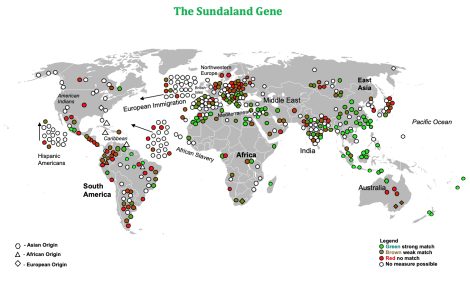
Distribution of highest frequencies of the Sundaland Gene. Green dots show the marker’s origins in Southeast and East Asia and spread to Austronesian satellite settlements in the Americas, Oceania, Sumer (Iraq), Egypt, Somalia and North Africa, among other places in prehistory. Note Madagascar, an Austronesian foundation attributed to Sea Gypsies from Island Southeast Asia.
ADDENDUM JAN. 3, 2026
It seems appropriate to begin a new year with a new portrait of American Indians from the same 1673 map mentioned above. In this picture, it is evident there is an Indian king and queen (an the queen carries a longbow), both very tall and lacking dark complexions, while curly-haired Melanesian-looking smaller Indians pan for gold in the mountains. The society depicted exactly tallies with the Prospector Culture and Austronesian genetic dispersals we document in our 2025 book The Countercurrents of Prehistory. The gold panners are not African or Negro, but Austronesian or Melanesian, a type found in New Guinea.
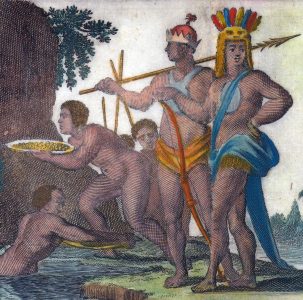
Dark-skinned Austronesian workers panning for gold in 17th century Florida (North Georgia).
Further Reading and Links
Survival International, “Uncontacted Peoples: at the edge of survival” (PDF)
Jose Toribio Medina, The Discovery Of The Amazon: According to the Account of Friar Gaspar De Carvajal and Other Documents (Kessinger: 2007)
Eduardo Barros Prado, The Lure of the Amazon (London: Souvenir, 1959)
Stephen Oppenheimer, Eden in the East: The Drowned Continent of Southeast Asia (London: Phoenix, 1998)
The Sundaland Gene (Rare Genes from History page)
The Denisovan Gene (Rare Genes from History page)
Donald N. Yates, The Countercurrents of Prehistory: What Rare Genes Can Say about Early Human Migration, illustrations by Richard L. Thornton, architect, with a foreword by Jane Mellin (Longmont: Panther’s Lodge Publishers, 2025)
Real All-Female Societies Reported in Brazil in 1954 (blog post, Jan. 11, 2025)
[1] S. E. B. Dos Santos et al, “Autosomal STR Analysis in Native Amazonian Tribes Suggest a Population Structure Driven by Isolation by Distance,” Human Biology 81/1 (Feb. 2009), pp. 71-88. The added populations are Awa-Guaja (n=34), Parakana (n=24), Tirijo (n=41), Urubu-Kaapor (n=68), Waipi (n=23) and Zoe (n=42).
[2] Elena S. Gusareva et al, “From North Asia to South America: Tracing the Longest Human Migration through Genomic Sequencing,” Science 388/6748 (15 May 2025).
[3] Donald N. Yates, The Countercurrents of Prehistory: What Rare Genes Can Say about Early Human Migration, illustrations by Richard L. Thornton, architect, with a foreword by Jane Mellin (Longmont: Panther’s Lodge Publishers, 2025), esp. Ch. 9, “Children of the Sun,” pp. 192-215.
[4] K. B. Schroeder et al, “A Private Allele Ubiquitous in the Americas,” Biology Letters (2007) 3, 218-223. See also K. B. Schroeder et al (2009). “Haplotypic Background of a Private Allele at High Frequency in the Americas,” Molecular Biology and Evolution 26/5, (2009), pp. 995-1016.
[5] Nicole Wyner, Mark Barash and Dennis McNevin, “Forensic Autosomal Short Tandem Repeats and Their Potential Association with Phenotype,” Frontiers in Genetics 6/11 (2020), 884, doi: 10.3389/fgene.2020.00884.
[6] Mary Ritchie Key, “Linguistic Similarities between Austronesian and South American Indian Languages,” Pre-Columbiana: A Journal of Long-Distance Contacts 1/1-2 (June and December 1998), esp. pp. 59-71.
James A Miller
1 February, 2026 at 10:26 pm
Interesting. My primary tribe on your DNA test is Lumbee, but some of these secondary South American tribes were also listed. I think this article will encourage me to study these tribes.
J. Smith
2 February, 2026 at 1:26 pm
I may be missing something, but I thought STRs mostly help with recent family history because they change fairly quickly. How can they be used to show very ancient migrations, instead of later mixing between populations?
Donald Yates
2 February, 2026 at 1:56 pm
You’re thinking of Y chromosome STRs, which mutate relatively rapidly. Our tests use autosomal STRs, which have a very low rate of mutation. No other company uses these forensic population markers for ancestry. Ancestry, 23&me, FTDNA and the host of other companies use Y chromosome STR profiles for Y chromosome tests. They use SNPs and algorithms for autosomal tests. We do not use algorithms for anything, nor do we use AI, just math and statistics.